Lenzing Fiber FAQ: What I Check Before Approving Any Fabric Order
-
What is Lenzing fiber, exactly?
-
Is Lenzing modal actually better for underwear?
-
Is Lenzing fiber natural or synthetic? (Neither.)
-
What specs do I put on every Lenzing fiber order?
-
How do I stop counterfeit Lenzing from getting into a Covington upholstery fabric order?
-
What about white linen suits labeled as "linen"?
-
What is cable knit fabric, and can it use Lenzing fiber?
-
What's one thing you'd do differently buying Lenzing the first time?
What is Lenzing fiber, exactly?
Lenzing is a company, not a fiber. Lenzing AG is based in Austria and produces a family of branded cellulose fibers: TENCEL™ Lyocell, TENCEL™ Modal, TENCEL™ MicroModal, and ECOVERO™ viscose. When a fabric mill says "we use Lenzing fabric," they usually mean TENCEL™ or Modal. They're being imprecise, and that imprecision matters on a spec sheet.
When I first started reviewing fabric specs, I assumed "Lenzing" meant one specific yarn. Took me about six months to figure out it was a brand family—like saying "Toyota" when you're actually trying to spec a specific engine. The first batch where I checked the actual fiber type listed vs. what was promised? Turned out to be a Modal/Lyocell blend labeled simply as "Lenzing." Not a disaster. But not what we ordered either.
Is Lenzing modal actually better for underwear?
For Lenzing modal underwear, the thing that actually separates good from great is the fine-touch spec. MicroModal runs at a finer denier than regular Modal—finer denier means a smoother hand and less pilling after 20+ wash cycles. But "better" only holds if the spec matches what's on the label.
In our Q1 2024 quality audit, we caught a Modal blend where the MicroModal content was about 30% lighter than the spec. The hand feel was there. The dimensional stability after washing? Not even close. That batch cost the supplier a full redo, and it cost us a delayed delivery window on a spring line. Since then, "fibre brand" on every PO means specific: TENCEL™ MicroModal, not "Modal."
Is Lenzing fiber natural or synthetic? (Neither.)
This is the question I wish more buyers asked. Lenzing fiber is regenerated cellulose—wood pulp (beech for Modal, eucalyptus for Lyocell) dissolved and reformed into fiber. The raw material is natural. The process is chemical. So neither label is quite right, and that distinction affects how you document it.
Per the FTC textile labeling rules (16 CFR Part 303), fiber content must be disclosed accurately. You can't legally just mark a Lyocell garment as "natural" on a spec sheet, and you shouldn't let a supplier hand-wave "biodegradable" as a feature claim without a specific test cited. OEKO-TEX Standard 100 is the reference most mills accept for restricted substances—if a supplier can't point to a certificate, I don't approve the batch.
What specs do I put on every Lenzing fiber order?
I run a 12-point checklist, but the ones that catch the most problems are: denier, fiber length, crimp, and oil/avivage content—plus the fiber content certificate that should arrive with each lot. Crimp is the one almost nobody checks. Bad crimp means yarn unevenness. Unevenness means fabric the mill can't fix and the customer will see.
We rejected a batch in 2023 where crimp was 8% below spec. The vendor claimed it was "within industry tolerance." We said the tolerance was ours, not theirs. They redid it at their cost. Honestly, five minutes of verification on a spec sheet beats five days of correction on a shipping line—every time.
How do I stop counterfeit Lenzing from getting into a Covington upholstery fabric order?
Covington upholstery fabric is a real brand category, and counterfeiters follow brands. Same logic applies to Lenzing: demand fiber content certificates and a verified chain of custody on each lot.
My experience is based on roughly 200 mid-range orders across apparel and home textiles. If you're sourcing luxury rolls or working with a supplier in a region I've never touched, your risk picture is probably different from mine. But in my segment, the most common trick is: TENCEL™ in the outer face, generic viscose in the backing, one carton label saying "Lenzing" for the whole roll. We require the certificate-of-origin batch number on every shipment. The honest mills produce it in five minutes. The other ones stall. That stalling tells you about 80% of what you need to know.
What about white linen suits labeled as "linen"?
White linen suits are a classic case where fiber-brand confusion meets consumer retail. A lot of "linen-look" suiting is actually Lyocell or a Lyocell/linen blend—Lyocell hits a similar cool hand and drape, but the fiber composition is different and the FTC requires the actual percentage on the label.
If I'm spec'ing a white linen suit program for a client, I ask for the fiber breakdown before I look at a single swatch. If the tag says "linen-touch" or "linen-style," assume it's a blend and price it as one. That's not a knock on Lyocell—it's a genuinely good fiber for this application. It's a knock on specs that don't say what they mean.
What is cable knit fabric, and can it use Lenzing fiber?
Cable knit fabric is a stitch structure, not a fiber—yarns twisted into crossing columns, usually on a flatbed knitting machine. So the question isn't whether Lenzing fiber "works" in cable knit (it does), it's what the yarn needs to do.
TENCEL™ and Modal both spin well into knitting yarns, but shorter staple Modal generates less fly during machine-knitting and leaves a cleaner needle bed. I've seen fewer dropped stitches on Modal-blend cable knits than on comparable viscose runs. Not a universal rule—honestly, I'm not entirely sure why the difference is as consistent as it is. My best guess is fiber-to-fiber friction, but I've never had a spinning engineer confirm it for me.
What's one thing you'd do differently buying Lenzing the first time?
Looking back, I should have made the fiber content certificate a hard requirement in the PO, not a "when the supplier remembers" add-on. At the time, I assumed a certificate attached to a quote meant a certificate attached to the shipment. They're different documents.
If I could redo my first Lenzing order, I'd add the certificate clause on day one, back it with a rejection right in the contract, and skip the three weeks I spent chasing paperwork after the first lot landed. But given what I knew then—nothing about how informal some mill relationships are—that first mistake was pretty reasonable. Doesn't make it cheaper to fix, though.
Five minutes of paperwork upfront. Five days of rework on the back end. That math hasn't failed me yet.
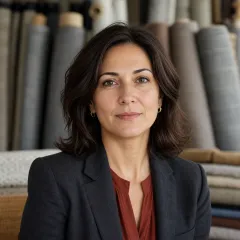
Lucia Bianchi
Lucia Bianchi is a woven apparel-fabric analyst covering cotton, linen, wool, rayon, denim, shirting, twill, satin, poplin, and blended garment fabrics. She applies the ISO 1833 series for fibre composition and ISO 105-C06 for laundering colourfastness while checking GSM, yarn count, usable width, shrinkage, skew, shade grade, drape, and surface defects. Her specification guides help designers, sourcing teams, and mills align fibre claims, lab dips, bulk tolerances, care conditions, and garment performance before production approval.